Reston, VA (November 13, 2024)—The International Atomic Energy Agency (IAEA) publishes
guidelines for the transport of all radioactive material. The current
guidelines are known as the IAEA Specific Safety Requirements Regulations for
the Safe Transport of Radioactive Material, 2018 Edition (SSR-6). Two federal
Agencies work with the IAEA to regulate the transportation of medical
radionuclides and radiopharmaceuticals in the U.S.: the Department of
Transportation (DOT) and the Nuclear Regulatory Commission (NRC). DOT and NRC
regulations are based, partly, on the international regulations issued by the
IAEA.
All shipments of radioactive materials, whether from
industry or government, must be packaged and transported according to strict
Federal regulations. There are three types of shipping packages for radioactive
materials: excepted packaging, type A packaging, and type B packaging. Almost
all radiopharmaceuticals are shipped in a type A package from
radiopharmaceutical manufacturers, medical radionuclide manufacturers, and
nuclear pharmacies. Type A packages go through a variety of testing
requirements before they can be used. The package must maintain containment
integrity during these tests, which are designed to emulate normal transport
conditions. In addition, the IAEA SSR-6
regulations set A1 and A2 values to ensure safe
containment and control in Type A packages, preventing accidental release or
exposure during transport.
Medical radionuclides and radiopharmaceuticals have short
half-lives, requiring frequent shipments—often every hour or daily—from
manufacturers and nuclear pharmacies to healthcare providers for patient care.
Each package is classified based on the quantity of radioisotope it contains,
following regulatory guidelines. Almost all transportation is completed in type
A packages. Current requirements for Type A packaging are identified in 49CFR 173.412. Along with these requirements, IAEA SSR-6 regulations provide
A1 and A2 values for safe containment and control during
transport to prevent unintentional release or exposure.
A1 value: The maximum activity of special
form radioactive material that can be transported in a Type A package.
A2 value: The maximum activity of all
other radioactive materials (excluding special form) that can be transported in
a Type A package.
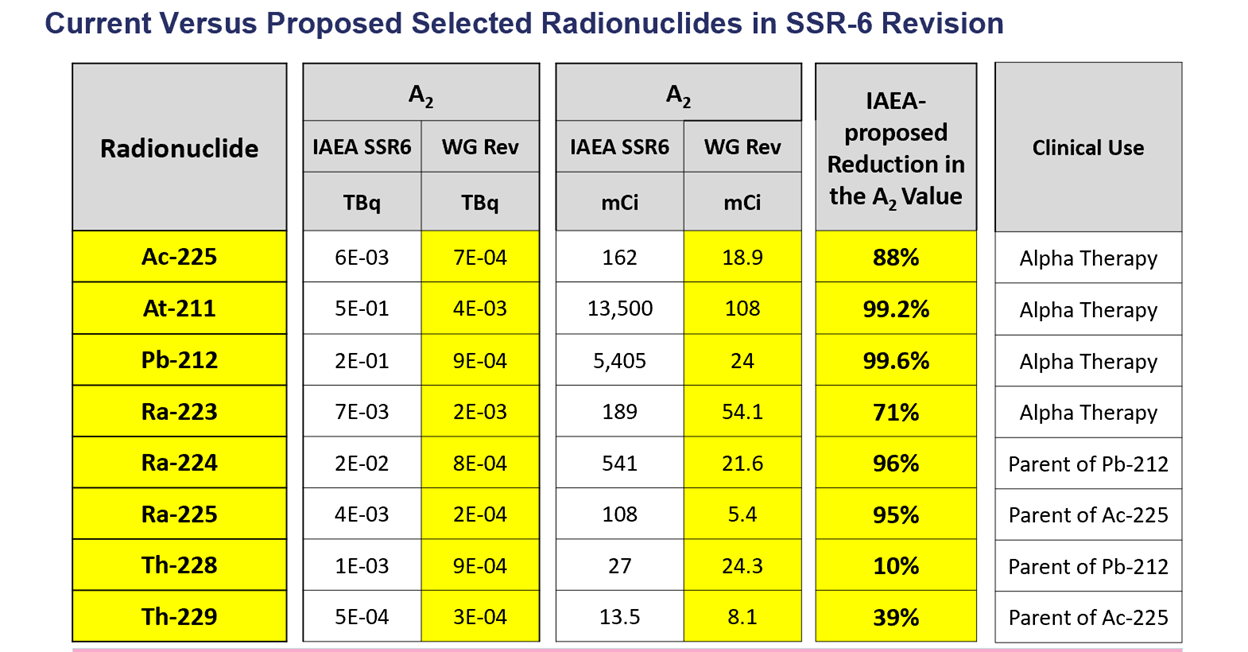
The IAEA is currently evaluating revisions to SSR-6,
including changes to A1 and A2 values. Notably, these include significant reductions in A2 values for medical
radionuclides that emit high-energy alpha particles directly or through
short-lived progeny. These include
isotopes such as actinium-225 (Ac-225), lead-212 (Pb-212), and astatine-211
(At-211) where A2 value overly conservative reductions exceed 85% –see table above. These alpha-emitting isotopes play a crucial role in advancing targeted alpha therapy (TAT) for cancer treatment, and their shipment remains
essential to the supply chain supporting this innovative therapy.
If the IAEA accepts the proposed changes to the A2 values in SSR-6, radiopharmaceutical manufacturers, medical radionuclide
manufacturers, and nuclear pharmacies may need to switch from type A to type B
packages or ship less activity in multiple Type A packages. A change of this
magnitude could create substantial challenges for TAT shipments, as limited
availability of Type B packages, higher costs, and increased regulatory
requirements would drive up transportation and package receipt expenses for
both the industry and healthcare providers. Ultimately, even with a possible
transition period, the proposed IAEA changes could greatly impact patient
access and cost of care.
The SNMMI is collaborating with industry and the respective
government regulators to advocate for a balanced approach that ensures the safe
and cost-effective transport of medical radionuclides and radiopharmaceuticals,
while voicing our concern about the proposed A2 value revisions.
If you would like to read more about the impact of the
proposed revision, please see the Council on Radionuclides and
Radiopharmaceuticals, Inc (CORAR) position paper.